
Mithras and Christianity
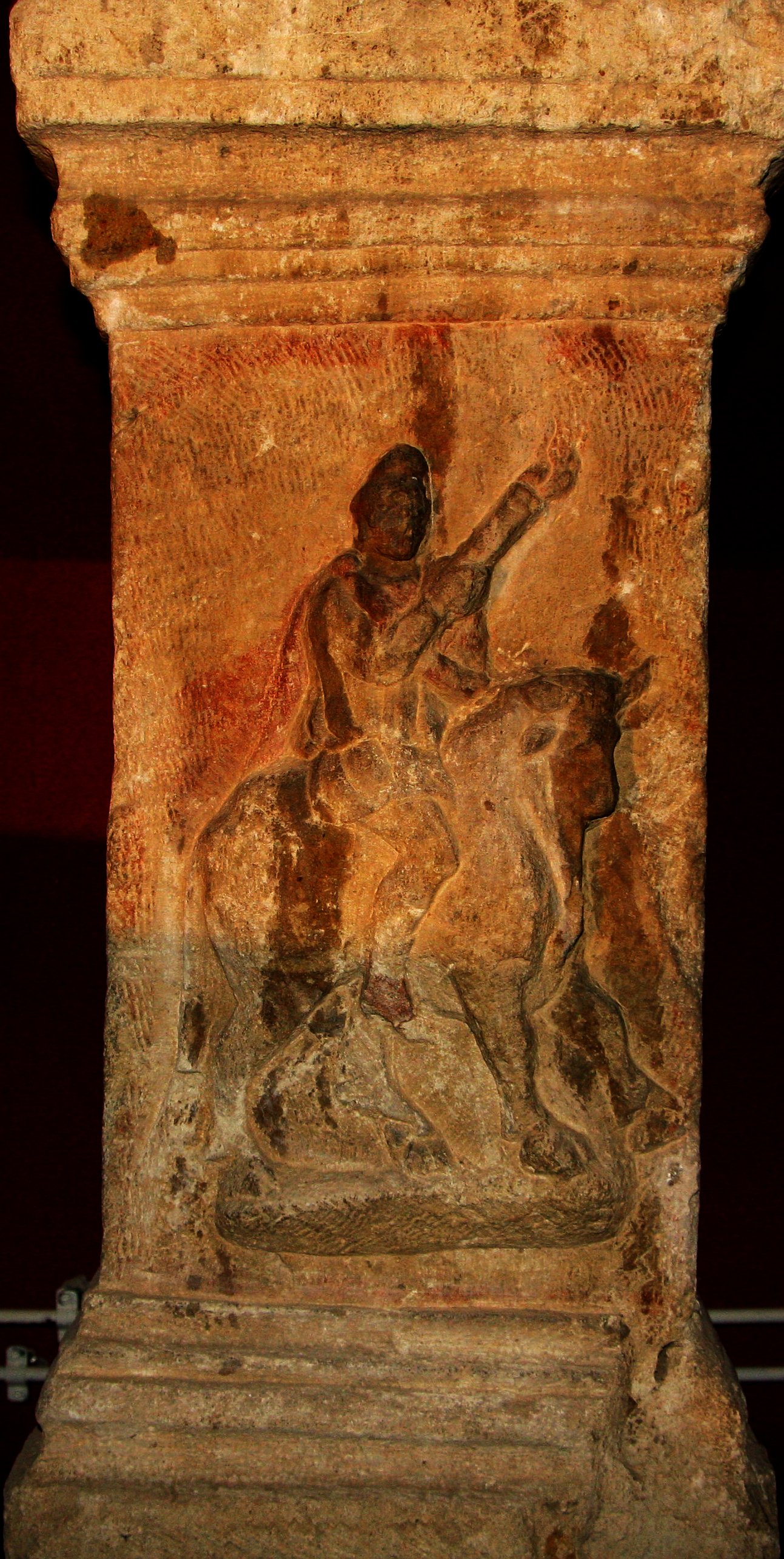
See also Mithras and other gods.
The idea of a relationship between early Christianity and the cultus of Mithras is based on a remark in the 2nd century Christian writer Justin Martyr, who accused the initiates of Mithras of imitating the Christian communion rite.1
Based upon this, Ernest Renan in 1882 set forth a vivid depiction of two rival religions: "if the growth of Christianity had been arrested by some mortal malady, the world would have been Mithraic."2 But at the time that Renan wrote, before Cumont had collected the sources, very little was known about Mithras.3
In fact the two groups had different objectives, and the cult of Mithras did not aim at a universal role, even at the peak of its popularity.4
There is no evidence of direct influence in either direction between the cult of Mithras and early Christianity.5 Rather such similarities as exist are attributed to the common environment in which both arose.
The philosopher Celsus in the second century provides some evidence that Ophite gnostic ideas were influencing the mysteries of Mithras.6
1. Ideas found in both Mithraic myth and Christianity
In older scholarly literature there appear a number of supposed similarities between Christianity and the cult of Mithras. In general these are based on speculation, or arise from attempts to shed some understanding on the cult of Mithras by looking at Christian ideas.
Vermaseren in 1975 wrote that the similarities arise from the presence of both in a shared cultural world.7 Likewise, rather than seeing borrowing in either direction, Manfred Clauss makes the same observation.8
A number of extremely wild claims -- that Mithras had 12 disciples, was a wandering teacher, died and rose again, etc. -- are discussed instead under Mithras and Jesus.
1.1. Born on 25 December
Cumont stated that the birthday of Mithras was 25 December, on the basis that a solar feast took place on that date and Mithras would, of course, be included. The idea was only speculation, but has been widely taken up.9 Clauss repeats the claim.10 But Beck states that this is not the case. In fact he calls this assertion 'that hoariest of "facts"'. He continues: "In truth, the only evidence for it is the celebration of the birthday of Invictus on that date in the Calendar of Philocalus. 'Invictus' is of course Sol Invictus, Aurelian's sun god. It does not follow that a different, earlier, and unofficial sun god, Sol Invictus Mithras, was necessarily or even probably, born on that day too."11
But later Clauss states; "the Mithraic Mysteries had no public ceremonies of its own. The festival of natalis Invicti [Birth of the Unconquerable (Sun)], held on 25 December, was a general festival of the Sun, and by no means specific to the Mysteries of Mithras."12
Steven Hijmans has discussed in detail the question of whether the general "natalis Invicti" festival was related to Christmas but does not give Mithras as a possible source.13
1.2. Salvation
A badly damaged painted text on the wall of the St. Prisca Mithraeum (CIMRM 485, c. A.D. 200)14 in Rome may contain the words: et nos servasti (?) . . . sanguine fuso (and you have saved us ... in the shed blood). The meaning of this is unclear, although presumably refers to the bull killed by Mithras, as no other source refers to a Mithraic salvation. The servasti has been treated as certain; but it is in fact only a conjecture, and Pancieri, the most recent archaeologist to examine the item, states that this must be wrong.15 According to Robert Turcan,16 Mithraic salvation had little to do with the other-worldly destiny of individual souls, but was on the Zoroastrian pattern of man's participation in the cosmic struggle of the good creation against the forces of evil 17
1.3. The water-miracle
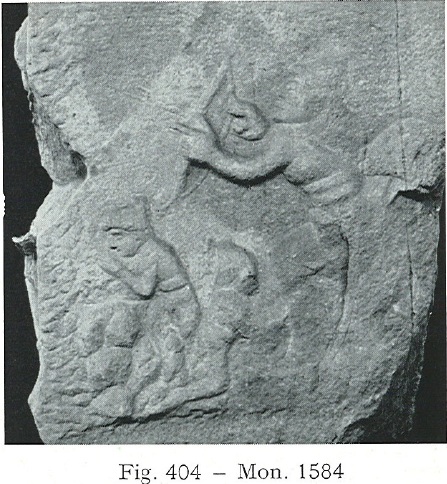
Monuments in the Danube area depict Mithras firing a bow at a rock in the presence of the torch-bearers, apparently to encourage water to come forth.18 Clauss states that, after the ritual meal, this offers 'the clearest parallel with Christianity'.19
1.4. Marked with the sign of the Cross
Some scholars have stated that initiates of Mithras were marked with the sign of the cross on their forehead. The idea has been described as a scholarly myth.20
The basis for the idea is found in Tertullian, who states that followers of Mithras were marked on their forehead in an unspecified manner.21 There is no indication that this is a cross, or a branding, or a tattoo, or a permanent mark of any kind.22
2. Mithraic motifs and medieval Christian art
From the end of the 18th century some authors have suggested that some elements in medieval Christian art reflect images found in Mithraic reliefs.23 Franz Cumont was among these, although he studied each motif in isolation rather than the combination of several elements and whether they were combined in Christian art in the same way.24 Cumont said that after the triumph of the church over paganism, artists continued to make use of stock images originally devised for Mithras in order to depict the new and unfamiliar stories of the bible. The "stranglehold of the workshop" meant that the first Christian artworks were heavily based on pagan art, and "a few alterations in costume and attitude transformed a pagan scene into a Christian picture".25
A series of scholars have since discussed possible similarities with Mithraic reliefs in medieval Romanesque art.26 Vermaseren stated that the only certain example of such influence was an image of Elijah drawn up to heaven in a chariot drawn by fiery horses.27 Deman stated that to compare isolated elements was not useful, and that combinations should be studied. He also pointed out that a similarity of image does not tell us whether this implies an ideological influence, or merely a tradition of craftmanship. He then gave a list of medieval reliefs that parallel Mithraic images, but refused to draw conclusions from this, as these would be subjective.28
3. Christian re-use of Mithraic sites and monuments
Several of the best preserved Mithraea, especially those in Rome such as at the Basilica of San Clemente, and that at Santa Prisca, are now to be found underneath Christian churches. In a number of cases churches were first built in the 5th century on top of ruined, high-prestige buildings, and some of these had once had Mithraea in the basements.29
There is evidence that the Mithraeum of the Baths of Mithras in Ostia may have been converted to a church by the middle of the 4th century. The date is based on the building technique, and the presence of the symbols alpha and omega.30
A study of early Christian churches in Britain concluded that the evidence there suggested a tendency to avoid locating churches on the sites of former Mithraea.31
In the early 11th Century tower added to the church of St.Peter-at-Gowts in Lincoln, England, there is a very weathered relief incorporated into the masonry, possibly from an unknown Mithraeum in Roman Lincoln. It has been supposed to be a relief of the lion-headed god, usually depicted with keys. It has been suggested that the relief may have been reused in the 11th century under the impression that it depicted St. Peter and his keys.32
4. Christian destruction of the Mithraea
There is no doubt that Mithraic caves were sometimes destroyed by Christians. Jerome mentions one such instance in Rome.33 Socrates Scholasticus tells us that the destruction of the Serapeum in Alexandria followed riots caused by the discovery by Christians of a disused Mithraeum (now lost) and the parading of the cult objects in mockery through the streets.34 Quite often damage to a Mithraeum is supposed to be caused by Christian axes. But some archaeologists have raised doubts.
From: Bryan Ward-Perkins, "The end of the temples: an archaeological problem", In: Johannes Hahn, Spätantiker Staat und religiöser Konflikt: Imperiale und lokale Verwaltung und die Gewalt gegen Heiligtümer, de Gruyter (2011), 187-197; this from p.194 (online preview):
As Richard Bayliss has recently pointed out, the archaeological evidence for Christian damage to temples is all too seldom clear-cut, and too often open to wishful thinking - as I also discovered when I tracked a number of supposed cases back to their original publications.23 Most disappointing was the evidence from the Mithraeum under the church of Santa Prisca in Rome, whose excavators believed they had found clear signs of its violent destruction by Christians, and which is cited by Sauer as a particularly good example of passionate religious iconoclasm.24 The cult-niche, with its stucco figures, was certainly badly damaged when discovered, and bits of the relief were found scattered around the room; many of the frescoes too were badly damaged. But a careful examination of the published photographs of the latter did not suggest to me that they had been savagely and systematically attacked with axes, as their excavators claimed; rather, the plaster looks to have been in a generally very poor state when uncovered, and to have decayed randomly across the wall. Even some frescoed heads, which should have been the first target of iconoclasts, were well preserved when excavated, including the haloed head of Mithras himself (which, we are told in the published report, was destroyed, not by fourth-century Christians, but by a botched attempt at restoration in 1953).25 As for the stucco figures in the niche - stucco is a fragile medium, and. while they might have been deliberately damaged, it also seems possible that they had decayed and fallen apart. The head of Mithras, although detached from its original setting, was found in very good condition - a Christian iconoclast could easily have crushed it under foot.23. BAYLISS 2004, 23-25. Bayliss discusses the thorny question of whether one can tell Christian destruction from that wrought by earthquakes, foreign invaders, or neglect. For earthquakes and temples, see ROTHAUS 2000. 39-44 and 60-61 - but see also the review (and subsequent debate) in the on-line Bryn Mawr Classical Review 2002.02.25. The case of Corinth is interesting: the excavations were good by earlier twentieth-century Mediterranean standards; but, even in this case, we cannot confidently say what brought the pagan buildings down.
24. VERMASEREN-VAN ESSEN 1965. 129-131, 151 and 241f. SAUER 2003, 134-136.
25. See VERMASEREN - Van Essen 1965, plates 53-65. The excavators too were puzzled at the survival of some of the sacred representations, though this did not deflect them from their overall interpretation: “After the destruction of the cult-niche and some of the monuments (though not others, the real meaning of which was not understood), the whole building was filled with rubbish" (VERMASEREN - Van Essen 1965, 241-242). Sauer (2003, 135-136) argues - at some length - that it was precisely because of their ‘passionate hate’ that the Christian iconoclasts wielded their axes so inaccurately! The head of Mithras, which, according to Sauer, was a particular focus of attack, is at the right-hand end of his fig. 63 (on p. 135). VERMASEREN and Van ESSEN (1965, 150) recount its true (and more banal) fate: “Of the head (of Mithras), only the outline has been preserved, with part of the halo; the rest of the face was lifted off in 1953 by the Istituto Centrale del Restauro, but did not respond to treatment and is now destroyed."
R. Bayliss, Provincial Cilicia and the Archaeology of Temple Conversion, Oxford, 2004. E. Sauer, The Archaeology of Religious Hatred in the Roman and Early Medieval World, Stroud, 2003. M.J. Vermaseren & C.C. van Essen, The Excavations in the Mithraeum at the Church of Santa Prisca in Rome, Leiden, 1965.
Better evidence is clearly needed.
| 1 | Justin Martyr, First Apology, ch. 66: "For the apostles, in the memoirs composed by them, which are called Gospels, have thus delivered unto us what was enjoined upon them; that Jesus took bread, and when He had given thanks, said, "This do ye in remembrance of Me, this is My body; "and that, after the same manner, having taken the cup and given thanks, He said, "This is My blood; "and gave it to them alone. Which the wicked devils have imitated in the mysteries of Mithras, commanding the same thing to be done. For, that bread and a cup of water are placed with certain incantations in the mystic rites of one who is being initiated, you either know or can learn." |
| 2 | Renan, E., Marc-Aurele et la fin du monde antique. Paris, 1882, p. 579: "On peut dire que, si le christianisme eût été arrêté dans sa croissance par quelque maladie mortelle, le monde eût été mithriaste." |
| 3 | Obviously; but remarked also by E. Yamauchi in various places. He is quoted in Lee Strobel, The Case for the Real Jesus, Grand Rapids, MI: Zondervan, 2007, p.175: '"Needless to say," continued Yamauchi, "Renan's work, published nearly 150 years ago, has no value as a source. He knew very little about Mithraism, and besides, we know a lot more about it today. Yet this is a quote that's commonly used by people who don't understand the context. It's simply farfetched."'. Yamauchi delivered a paper at the IInd International Congress on Mithraic Studies in Tehran in 1975; E. Yamauchi, 'The Apocalypse of Adam, Mithraism and Pre-Christian Gnosticism', J. Duchesne-Guillemin (ed.), Études Mithraiques, (Acta Iranica IV; Leiden/Teheran/Liège, 1978), pp. 537-63. In "Pre-Christian Gnosticism, the New Testament and Nag Hammadi in recent debate", Themelios 10.1 (September 1984): 22-27, online here, Yamauchi refers to "my attempt to date the ApocAd on the basis of the allusion to the well-known Mithraic motif of the 'birth from a rock' (CG V, 80.24-25) in a paper which I presented at the IInd International Congress of Mithraic Studies at Teheran in 1975.90 On the basis of the epigraphic and iconographic evidence collected by M. J. Vermaseren, I sought to demonstrate that this topos was not known before the second century AD and that the probable provenance for knowledge of such a motif for a Gnostic writer was Italy." Edwin M. Yamauchi, "Easter: Myth, Hallucination, or History?" Christianity Today on March 15, 1974 and March 29, 1974. Online here. |
| 4 | J. A. Ezquerra, tr. R. Gordon, Romanising oriental Gods: myth, salvation and ethics in the cults of Cybele, Isis and Mithras. Brill, 2008, p.202-3: "Many people have erroneously supposed that all religions have a sort of universalist tendency or ambition. In the case of Mithraism, such an ambition has often been taken for granted and linked to a no less questionable assumption, that there was a rivalry between Mithras and Christ for imperial favour. ... If Christianity had failed, the Roman empire would never have become Mithraist." Google books preview here. |
| 5 | Gary Lease, "Mithraism and Christianity", in: ANRW II, p.1328: "To be specific, it is clear that the few scattered remarks in Christian polemical literature against Mithraism, together with the scanty archaeological remains of the Mithraic religion, do not bear out a direct influence of one religion upon the other." |
| 6 | Clauss, M. The Roman Cult of Mithras, p.17, referencing Origen, "Contra Celsum" book 6, cc.22-24 where a ladder of seven steps is described, similar to one used by the Ophites. Clauss states that the borrowing was by the Mithraists, but nothing in Contra Celsum seems to say so. |
| 7 | M.J. Vermaseren, "Nuove indagini nell'area della basilica di S. Prisca in Roma", in Mededelingen van het Nederlands Instituut te Rome. Antiquity, n.s., 37, 2 (1975), pp. 87-96: "Questi inni aprono ancora molte altre prospettive. Così il collega Hans Dieter Betz, professore all’Università di Claremont in California, ha pubblicato dopo the Excavations un articolo di grande valore intitolato "The Mithras inscriptions of Santa Prisca and the New Testament".(24) Il Betz fa notare specialmente il parallelismo di centri pensieri cristiani con idee espresse in questi inni pagani derivati da una fonte comune ellenistica. Oggi ognuno può affermare che proprio questo Umwelt ellenistico-romano è la causa fondamentale di queste concezioni simili nel cristianesimo e nel paganesimo, concezioni poi elaborate in diversi modi con un suo valore proprio. Per fortuna ognuno considera come completaménto sbagliato (25) una negazione di questo principio che quindi potrebbe condurre a risultati disastrosi per la scienza. In queste stesse fonti ellenistiche sono da ritrovare diverse idee comune al cristianesimo ed alle religioni misteriosofiche, come le ha chiamate mia volta Nicola Turchi.(26)" (These hymns are open to still other interpretations. Thus my colleague Hans Dieter Betz, professor of the university of Claremont in California, has published about "the excavations" an article of great value entitled, "The Mithras inscriptions of Santra Prisca and the New Testament".(24) Betz notes specially the parallelism between central Christian thought and the ideas expressed in these pagan hymns derived from a common hellenistic origin. Today everyone can say that precisely this Hellenistic-Roman Umwelt is the fundamental cause of those concepts which are similar between Christianity and paganism, concepts that are then elaborated differently in various ways. Thankfully everyone considers the denial of this as completely wrong (25), and which could lead to disastrous results for science. In these same Hellenistic sources may be found various ideas common to Christianity and the mysteriosophical religions, as my colleague Nicola Turchi has called them.(26)) |
| 8 | M. Clauss, The Roman cult of Mithras. (In the chapter on Christianity: TODO verbatim quote) |
| 9 | The statements by Franz Cumont are discussed here. |
| 10 | Manfred Clauss, The Roman cult of Mithras, p.66: "Light comes from the firmament, Mithras is the god of light, the new light which bursts forth each morning from the vault of heaven behind the mountains, and whose birthday is celebrated on 25 December. A late antique Syriac commentator describes this festival, and correctly observes that it later developed into the birthday of Christ: 'It was in fact customary among the pagans to celebrate the festival of the Sun's birthday on 25th December and to light bonfires in honour of the day. They even used to invite the Christian population to these rites. But when the teachers of the Church realised that Christians were allowing themselves to take part, they decided to observe the Feast of the true Birth on the same day.80' It may be that the Mithraists also celebrated the birthday of their god in public in a similar manner." The note 80 reads "Cited in CIL 12 338-9." Clauss is mistaken here, however; the text is 13th century, by the scholiast to Dionysius bar Salibi, and does not refer to Mithras. |
| 11 | Roger Beck, "Merkelbach's Mithras", Phoenix 41.3, 1987, p.296-316, p. 299, n. 12. |
| 12 | Clauss, Manfred. Mithras: Kult und Mysterien. München: Beck, 1990, p. 70: "... erwähnenswert wäre dass das Mithras-Kult keine öffentlichen Zeremonien kannte. Das Fest der natalis Invicti, der 25. Dezember, war ein allgemeines Sonnenfest und somit keineswegs auf die Mithras-Mysterien beschränkt. Es gab also im Mithras-Kult nichts vergleichbares zu den großen Feiern und Festlichkeiten anderer Kulte ...". |
| 13 | Steven Hijmans, "Sol Invictus, the Winter Solstice, and the Origins of Christmas", Mouseion 3, 2003, p.377-398. |
| 14 | Journal of Mithraic Studies vol. 2 |
| 15 | Panciera, Il materiale epigrafico dallo scavo del mitreo di S. Stefano Rotondo, in: Mysteria Mithrae (conference 1978 published 1979), p.87-126. Relevant portions online here. |
| 16 | Turcan, Robert, "Salut Mithriaque et soteriologie neoplatonicienne," La soteriologiea dei culti orientali nell'impero romano,eds. U. Bianchi and M. J. Vermaseren, Leiden 1982. pp. 103-105 |
| 17 | Beck, Roger, Merkelbach's Mithras, p.301-2 |
| 18 | Clauss, M. The Roman Cult of Mithras, p.71-2: "The theme of the water-miracle is elaborated mainly in the Rhine-Danube area. Mithras is usually represented sitting on a stone and aiming a flexed bow at a rockface, in front of which there kneels a figure. Another figure sometimes grasps Mithras' knees in supplication, or stands behind him with his hand on his shoulder. The scene is particularly striking on the large altar from Poetovio I ... Mithras here is aiming his bow at a rockface, from which water will shortly gush forth - a person is standing in front of it ready to catch the water in his cupped hands. ... We may note that the figures who are generally shown taking part in this scene with Mithras are clothed just like the god. They must be the torch-bearers, present here just as they are at the rock-birth and the killing of the bull. This scene can thus be connected with one of the lines in the mithraeum under S. Prisca in Rome, which is addressed to a spring enclosed in the rock: 'You who have fed the twin brothers with nectar'.8 6 The spring is Mithras; the twins to whom he has given heavenly nourishment are the torch-bearers." (The Ptuj / Poetiovo reference seems to be CIMRM 1584) |
| 19 | Clauss, M. The Roman Cult of Mithras, p.72 continues: "Apart from the cult-meal, the water-miracle offers the clearest parallel with Christianity, spreading through the Empire at the same period as the mysteries of Mithras. The thinking that underlies these features of each cult is naturally rooted in the same traditions. The water-miracle is one of the wide-spread myths that originate from regions plagued by drought, and where the prosperity of humans and nature depends upon rain. Each in his own manner, Mithras and Christ embody water, initially as a concrete necessity, and then, very soon, as a symbol. Christ is referred to in the New Testament as the water of life. Many Christian sarcophagi depict the miracle of Moses striking the rock with his staff and causing water to flow (Exodus 17.3-6), as a symbol of immortality." |
| 20 | Per Beskow, "Branding in the Mysteries of Mithras?", in Mysteria Mithrae, ed. Ugo Bianchi (Leyden 1979), 487-501. He describes the entire idea as a "scholarly myth". See also FAQ by Dr. Richard Gordon. |
| 21 | Tertullian, De praescriptione haereticorum 40: "if my memory still serves me, Mithra there, (in the kingdom of Satan, ) sets his marks on the foreheads of his soldiers; celebrates also the oblation of bread, and introduces an image of a resurrection, and before a sword wreathes a crown." |
| 22 | Per Beskow, "Branding in the Mysteries of Mithras?", in Mysteria Mithrae, ed. Ugo Bianchi (Leyden 1979), 487-501. He describes the entire idea as a "scholarly myth". See also FAQ by Dr. Richard Gordon; Luc Renaud, Les initiés aux mystères de Mithra étaient-ils marqués au front? Pour une relecture de Tertullien, De Praescr. 40, 4, in: Bonnet, C. / Ribichini, S. / Steuernagel, D. (ed.), Religioni in contatto nel Mediterraneo antico : modalità di diffusione e processi di interferenza, Actes de colloque (Come, mai 2006), Pisa / Rome, Fabrizio Serra Editore (Mediterranea, IV), 2007, p. 171-180. German translation here. |
| 23 | A. Deman, "Mithras and Christ: Some Iconographical Similarities," in: John R. Hinnells, Mithraic Studies, vol. 2, Manchester University Press, 1971, pp. 507-17. p.507. |
| 24 | A. Deman, "Mithras and Christ: Some Iconographical Similarities," in: John R. Hinnells, Mithraic Studies, vol. 2, Manchester University Press, 1971, pp. 507-17. p.508. |
| 25 | Franz Cumont, tr. Thomas K. McCormack, "The Mysteries of Mithras", Dover Publications, 1956, pp. 227-8. |
| 26 | A. Deman, "Mithras and Christ: Some Iconographical Similarities," in: John R. Hinnells, Mithraic Studies, vol. 2, Manchester University Press, 1971, pp. 507-17. p.509. |
| 27 | M. J. Vermaseren, "Mithras: The Secret God", Chatto & Windus, pp. 104-6. |
| 28 | A. Deman, "Mithras and Christ: Some Iconographical Similarities," in: John R. Hinnells, Mithraic Studies, vol. 2, Manchester University Press, 1971, pp. 507-17. p.510. |
| 29 | Lucrezia Spera, "Characteristics of the Christianisation of Space in Late Antique Rome: New Considerations a Generation after Charles Pietri's Roma Christiana", in: Cities and Gods: religious space in transition, ed. Ted Kaizer &c., Peeters, 2013, p.121-142 (online here, p.128: "In general, there may be some basis for the idea that on the Aventine as on the Caelian the planning of the Church of Rome was inserted to some extent within 'empty spaces' that began to appear in the urban network after the destabilising event of the sack of the City." |
| 30 | Milton Luiz Torres, "Christian Burial Practices at Ostia Antica: Backgrounds and Contexts with a Case Study of the Pianabella Basilica", Diss. 2008, p.72.: "There is also a mithraeum seemingly converted to Christian use at the Baths of Mithras (Fig. 6)." |
| 31 | Ronald Hutton, "The Pagan Religions of the Ancient British Isles;their nature and legacy", Blackwell, 1991, ISBN 0631189467, p.260. |
| 32 | David Stocker, "A Hitherto Unidentified Image of the Mithraic God Arimanius at Lincoln?", Britannia 29, 1998, p.359-363. |
| 33 | Letter 107, to Laeta. See here. |
| 34 | Socrates Scholasticus, Church History, book 3, chapter 2. See here. |
| Tweet |